2026/09/07
The Packaging Has to Come Back, or the Business Doesn't Work
Chris Tang, former head of operations at PackAge+, unpacks the five key challenges of the circular economy from five and a half years of first-hand experience, from a courier's marker pen to what to do before bringing in AI.
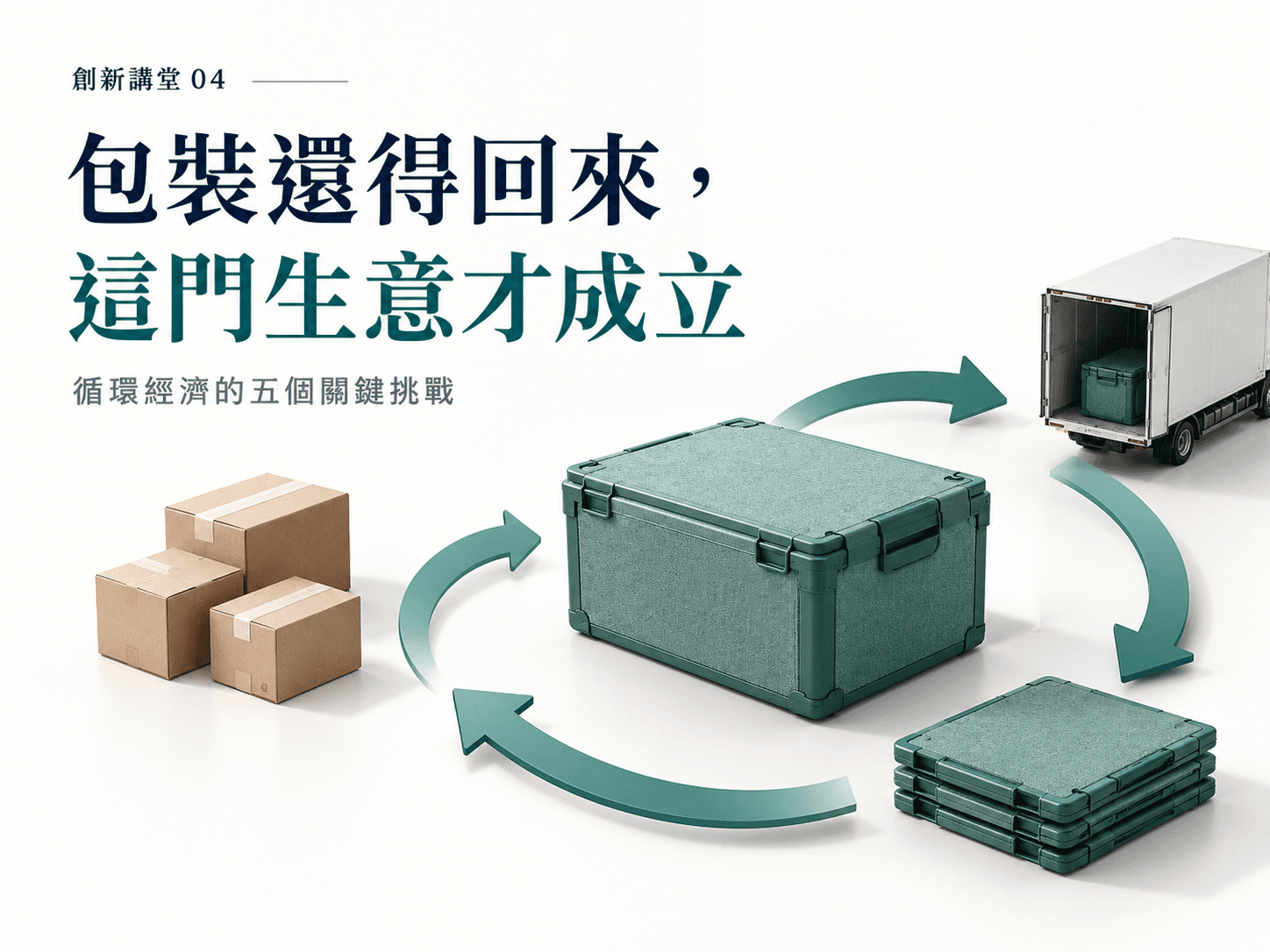
For our September online meeting on 7 September we invited Chris Tang (湯士賢), former head of operations at PackAge+ (配客嘉), a Taiwanese company that makes reusable packaging for e-commerce. He spent five and a half years there, starting as a service designer and ending up running the whole operations department, and left in April this year. He now teaches part-time at two universities and advises a small business on operations.
He didn't open with a vision. He opened with a photo of a convenience store buried in parcels the day after the Singles' Day shopping festival, every outer layer destined to become rubbish thirty seconds after being opened. That image, he said, is where the founder started asking whether the packaging could be used more than once.
For the next hour and more he talked about the five walls the idea hit once it left the whiteboard: stakeholder needs, managing return points, product development, the business model, and social impact. He mapped them onto the three circles of design thinking (desirability, feasibility, viability) plus a fourth he added for social innovation: impact.
Every pitfall was concrete
The packaging was originally light grey and later switched entirely to black. Not because black hides dirt, but because couriers delivering two hundred parcels a day write the delivery zone code on the bag with a permanent marker, and every logistics company uses a different code. The ink doesn't come off, so a single delivery would write off a bag. In black, the writing barely shows.
Return boxes had the same problem. Put a box in a convenience store and it quickly becomes a bin. They tried baffles, warning stickers, "CCTV in operation" signs. None of it worked, because the people returning bags don't read signs. The fix wasn't persuading consumers. It was plugging the service into something store clerks already do every day: scanning a barcode. Scan it, the system pops up, the clerk knows what to do. Getting that one piece of information onto the convenience store terminals took nearly two years of negotiation.
His rule: if your service runs on someone else's system, you can't depend on people's memory or training. You can only depend on the action they already perform every day.
Before bringing in AI, he did something very un-AI
His last project before leaving was helping the company prepare to adopt AI. Three steps, and the first has nothing to do with AI.
- Lay out every process in the company. Not one process, all of them: how products are developed, how sales negotiate, when work hands off to the back office, how complaints are handled, how long it takes finance to get paid. One big map.
- Pick the nodes worth fixing, together with each department, using four criteria: the most stuck, the most painful, the biggest impact on revenue, and the widest reach.
- Only then decide the solution. And it isn't necessarily AI. It might be handing a task to a person, fixing an existing system, or connecting two systems that don't talk to each other.
His observation is that small and medium businesses rarely have one integrated system. They run on forms, tools and people stitched together, and the seams between systems are the biggest obstacle. Some nodes simply can't be solved by AI in the short term. Know how the company actually works first, and then you'll know where AI belongs.
Choosing a problem worth years of your life
Most people go in this order: I want to start a company, let me find a social problem, and only at the end ask whether I like it. He suggested flipping it around and starting with yourself. If your motivation comes from outside, doing AI because AI is hot or sustainability because sustainability is hot, then when the wind changes you'll quit. The only thing that carries you through the trough is your own connection to the problem.
Three things he learned in five and a half years
Believe first, then you'll see. Usually it's the other way round. Every year during planning the team asked which goals they simply had to believe were achievable. His examples were the convenience-store partnership and the packaging regulations coming into force, two things nobody dared believe would happen at the time.
Face problems honestly. Most of what he ran into wasn't a technical problem or a money problem. The common situation was that every analysis said go, but nothing moved, and the person who was stuck wouldn't say why. The real reason was often something they didn't want to do, sometimes unrelated to work. Until that's said out loud, you'll never find where things are stuck.
Have you hit your ceiling? The Peter Principle. At some point you get stuck at the limit of your own ability, and the company gets stuck with you. He flipped the old saying around: the boss's ceiling is the company's ceiling. So keep asking whether the thing that's stuck is you, and which problems you're actually avoiding.
A thought after the session
The best part wasn't the method. It was his willingness to show the side that hasn't been tidied up yet. None of the five challenges was a framework worked out after the fact. All of them were walls he actually hit and took years to get around. Q&A ran far longer than planned, from negotiating with retail channels and why customers pay, to dust-proof design for cleanrooms and which operating metrics to watch. He answered every question directly, said "I don't know" when he didn't, and "that's not my area" when it wasn't.
If you take one thing home, take the part about facing problems honestly. Many of the situations we blame on lack of resources or the wrong method come down, in the end, to nobody saying what they really think. You don't need to be a big company for that to apply. You can start at next week's meeting.
Next up
Innovation Talk 05 is on 5 October. The speaker is Louis Wu (吳建志), innovation consultant at the Digital Transformation Institute of the Institute for Information Industry and founder of the biotech startup 玄蜜生技. Topic and registration will be announced on the club's events page.
This recap was compiled by the Innovation & Entrepreneurship Committee of Taipei Fusion Rotary Club. The speaker's own remarks at the session take precedence.